
Imagine a city where garbage trucks go to paper mills instead of landfills.
Imagine a world in which those ever-increasing piles of organic waste aren’t rotting and releasing methane but being made into crisp, beautiful stationery. Envision your local artisans thriving as they craft packaging from invasive plants. And if the filth that clogs our cities could be spun into value?
This is not just a daydream. It’s the real-life version of turning city grime into green treasures, the process of waste paper recycling.
The Urban Waste Crisis: Why This Matters
Every modern city in the world has to deal with waste. From agricultural and food waste and garden waste to textile clippings, urban areas generate millions of tons of rubbish every day.
Usually, it goes to one or two places: burned in open air, polluting our lungs with smoke, or piled up in landfills that contaminate the groundwater. There is a third, greener way. In embracing waste paper recycling, we can divert these huge waste streams and turn them into tree-free paper. This is not just about how to handle garbage; it is about how to think of garbage as a resource.
What Can Be Turned Into Paper?
When it comes to recycling, we mostly think of used newspapers. However, the range of the waste paper is much wider and more interesting. Nature offers plenty of fibrous material that is suitable for making paper.
Here are just a few waste streams that can be saved from the landfill:
- Crop Waste: Rice straw, sugarcane bagasse and banana fiber are fatty acid rich materials that farmers burn.
- Garden Waste: Neem leaves, bougainvillaea and grass clippings are typical city trimmings.
- Invasive Plants: Water hyacinth and lantana, that choke our lakes and forests, are top tier paper.
- Market Refuse: Vegetable and fruit peels; pineapple leaves.
- Textile Waste: Cotton rags (hosiery) and denim scraps are the gold standard for strong paper.
- Industrial Waste: Spent barley from breweries, coffee husks and coconut coir.
Through innovative waste paper recycling, every one of these items can become pulp, proving that we don’t need to cut down forests to write a letter.
The Magic of Transformation: How It Works
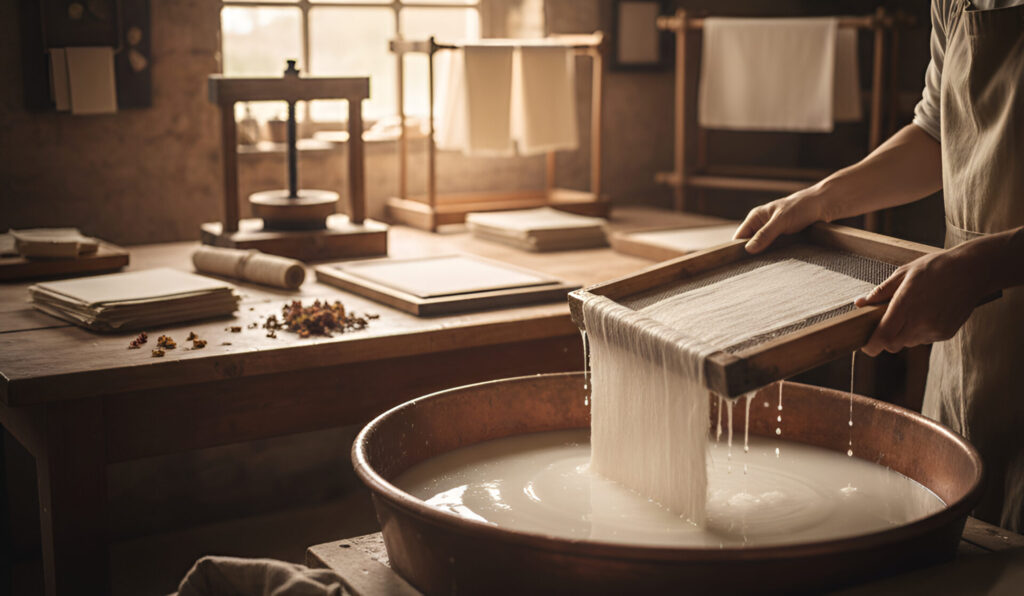
Making a sheet of paper from a banana stem or a scrap of denim is part science, part art. A straightforward explanation for the process of recycling waste paper on the ground would be like this:
- Collection: The municipality or a cooperative collects dedicated waste (e.g. textile rags, agricultural husks).
- Sorting & Cleaning: The raw materials are sorted carefully to eliminate non-fibrous materials.
Boiling & Pulping: The substance is boiled to separate lignin and defibrillated. - Sheet Formation: Using traditional deckles or contemporary moulds, artisans lift the pulp into sheets.
- Pressing & Drying: Water is pressed out, and the sheets are sun dried or air dried.
- Finishing: The paper is calendared (polished) to give a perfect writing or packaging surface.
Environmental Benefits: Healing the City
Sustainability often gets a reputation for being expensive, but waste paper recycling actually makes economic sense for cities.
For municipal bodies, converting waste into paper from waste means saving millions on landfill management and transportation costs. It opens up a new raw material supply chain for local mills and artisans, reducing dependency on imported wood pulp.
Furthermore, it creates a unique market for “hyper-local” paper. Imagine a city’s schools using notebooks made from that very city’s textile waste. This boosts green startups and creates export opportunities for high-quality, sustainable manufacturing goods.

Real-World Examples of Success
The movement is now! Around the world, innovation is pushing the waste paper recycling industry to a new level.
- Rice Straw Activities: A number of Asian nations are actively transforming rice straw (typically a source of air pollution when burnt) into premium-grade paper.
- Banana Fiber Initiatives: In tropical countries, banana stems are converted into tough paper for artistic packaging.
- Bengaluru’s Textile Revolution: Closer to home, the massive amount of cotton offcuts from the garment industry is being intercepted and turned into premium bond paper.
These examples prove that paper recycling is scalable, practical, and profitable.
Challenges Cities Must Overcome
The vision is bright, yet there are still hurdles. To turn waste paper recycling into a standard practice in the city, we have to overcome a few challenges:
- Local Collection: We have to develop better means of waste separation at the source, so that paper mills get clean raw materials.
- Technology Investment: Investment in machinery to process a variety of fibers (such as coarse coconut coir) is needed.
- Consistency: Waste is variable in quality, unlike wood pulp. Skilled artisans are needed to keep the paper texture consistent.
- Public awareness: Consumers have to make a conscious choice for tree-free paper to create the demand.
How Bluecat Paper Leads the Way
At Bluecat Paper, we don’t just talk about the potential of waste; we live it every day. We have proven that waste paper recycling results in products that are not only sustainable but luxurious.
We convert 100% waste into paper; absolutely no trees are cut in our process. From the invasive water hyacinth clogging our waterways to the cotton rags discarded by factories, and even elephant dung or residual barley from beer production, we embrace it all.
Our model demonstrates that sustainable manufacturing is possible, profitable, and beautiful. We are living proof that a city’s waste can indeed become its greatest creative asset.
Conclusion
Let’s return to our “what if” scenario.
If every city committed to waste paper recycling, the results would be profound. Landfills would shrink, reclaiming land for parks and housing. The air would be clearer without the smoke of burning crop waste. And our daily stationery would tell a story of renewal rather than destruction.
Waste is not to be wasted. Seeing it as a resource, we can create a circular future where nature and business co-exist.