A quiet revolution is transforming material science as the pressures for global sustainability mount. Producers of everyday products are increasingly looking for alternatives to conventional, energy-intensive processes, especially in the area of papermaking, which has traditionally been linked to deforestation, large water use, and chemical processing. This pursuit for eco-innovation has resulted industry leaders re-emerging and reinventing methodologies that take advantage of plentiful agricultural residue, converting an environmental burden into a precious commodity. The highest realisation of this circular-economy philosophy is the production of high-quality, tree-free paper. Leading the charge in this evolution is Eco-friendly Corn Husk Paper, a product that delivers exceptional environmental benefits while still meeting high standards for visual appeal and durability.
What Defines Eco-friendly Corn Husk Paper?
Eco-friendly Corn Husk Paper is a premium non-wood fiber paper made from up to 80 % of corn husks, the outer shell of a corn cob. This is a great example of material waste valorization. Corn husks are what is left over after you harvest the kernels from the cobs, and they’re generally regarded as agricultural waste, tossed aside in huge piles. Intercepting this agricultural byproduct, Bluecat Paper and others are turning what would typically be post-consumer waste — ending up in landfills or burned in ways that damage the environment- into a strong, resource-smart feedstock.
Adopting this fiber stream, however, has significant implications in the long term for both the desirability of ethical sourcing and for scaling. More than a billion tonnes of corn grain are produced annually, making it the most produced grain worldwide. Such scale facilitates the provision of a continuously renewable and universally available fiber source that does not vie for land to grow food crops for supply, as conventional virgin wood sources do. The abundance and accessibility of corn husks make sustaining supply over long periods of time not a problem – definitely a critical issue for the B2B partners hoping to secure a steady stream of sustainable materials. In addition, the material lends itself naturally to circular material flow, allowing for a reduction in the whole environmental effect of paper making. How to make paper out of cornhusks? The natural composition of the husks gives them a natural, light shade of green-yellow colour, so no synthetic dyes or chemical bleaches are needed to provide an attractive look.
Making Paper from Corn Husks: The Artisanal and Tree-Free Process
Turning corn husks into attractive, serviceable paper is a rigorous procedure, combining hand production methods with contemporary ideas on sustainability. The path begins with the careful gathering of post-harvest husks, removing them from such processes as burning, which adds carbon and smog to the atmosphere.
Preparation and Fiber Breakdown
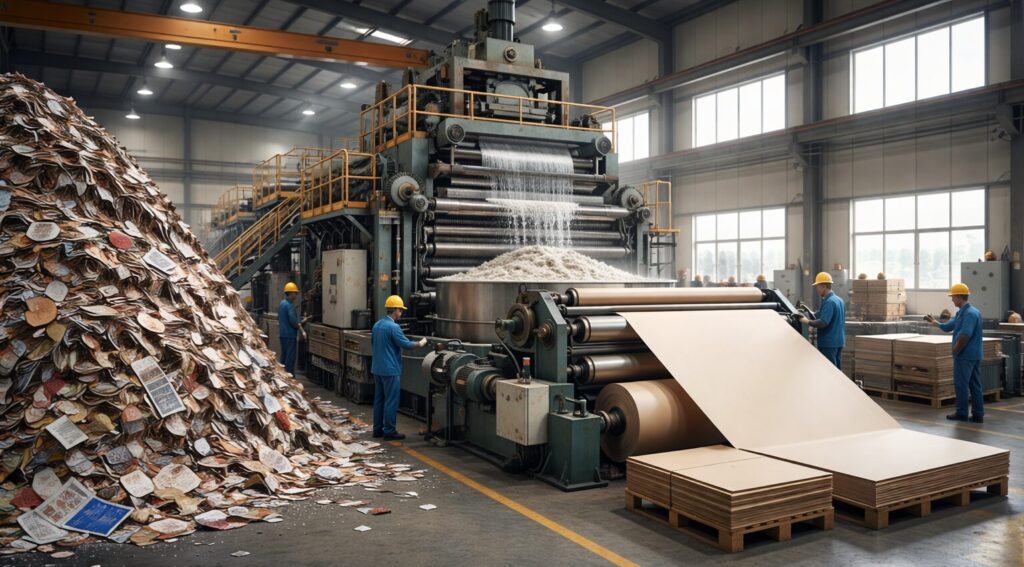
After that, the husks are cleaned, sorted and processed for pulping. But unlike wood, which needs to be chemically digested in multiple stages to remove very high levels of lignin, corn husks can be broken down in a simpler process that’s more mechanical in nature. The fibers are frequently cooked in an alkali solution like soda ash to eliminate non-cellulose elements such as wax and lignin so that the cellulose fibers can be freed up from each other. This dependency on mechanical pulping and less chemical processing in it leads to a much lower energy utilization process than that of complex normal wood pulping. The key differentiation in this production chain is the absolute commitment to tree-free processes at each and every step, which encompasses that entire process from swelling the pulp to drying the paper rolls to creating and printing with natural dyes – Not even one drop of wood pulp at any point.
Blending for Enhanced Performance
Although corn husk fiber (CHF) has a high cellulose content (about 23% cellulose with 63% hemicellulose), like non-wood fibers in general, its fiber length is shorter than those of wood fibers, which affects the tensile strength. To balance this, and to make sure that the product is strong, durable, and commercially viable for printing and packaging, Bluecay Paper employs a complex blending system. The corn husk pulp is combined with other strong, upcycled fibers, like cotton rags or flax. This is where fibre reinforcement, a green commitment to circularity, comes in – these blending fibers are, in fact, waste streams.
Sheet Formation and Resource Efficiency
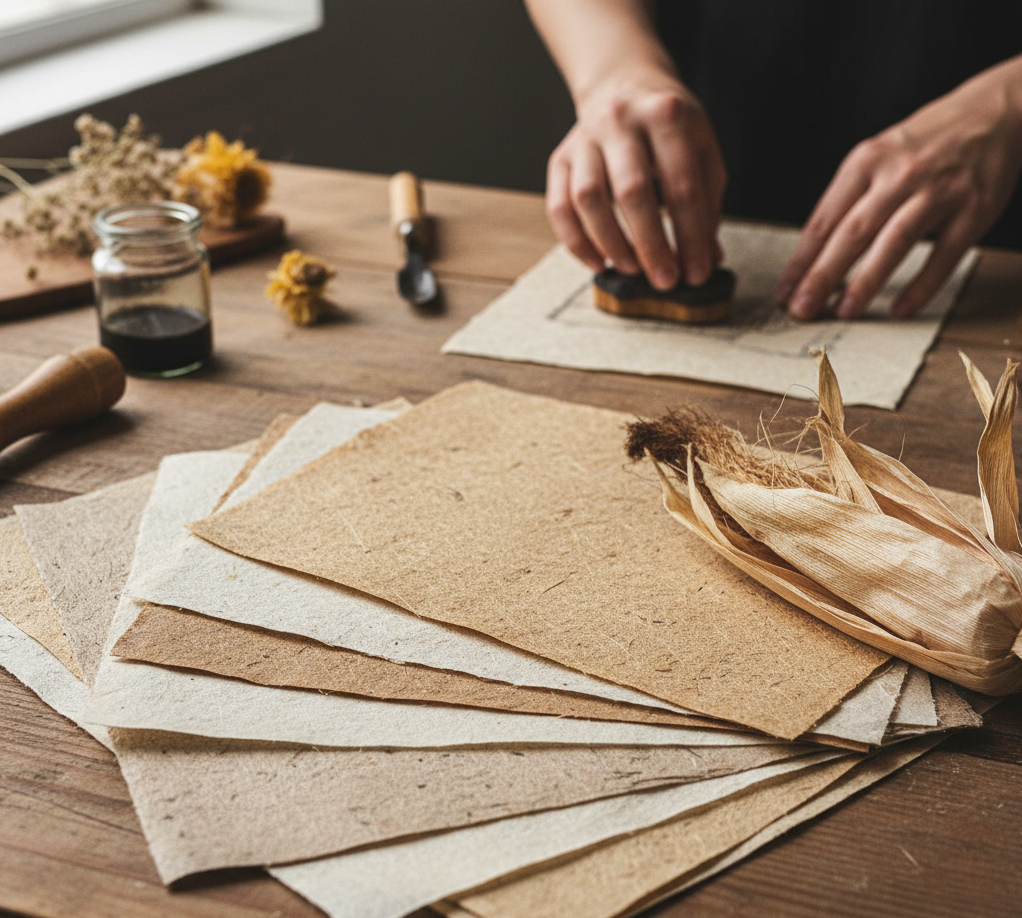
The blended fiber slurry is then poured onto a traditional mould and deckle to make individual sheets. This is a process that is done by hand, and it guarantees that no two sheets are the same. These wet sheets are pressed to remove water, then air-dried naturally for a superior texture and strength, a process that takes about 24 to 48 hours. Apart from the source of materials, Bluecat Paper is also environmentally friendly in its operations. The plant features water-recycling that reuses a substantial quantity of water and energy, which results in conserving 55,000 liters of water every day over traditional mills. This rigorous, conscious approach to process ensures that the future of paper is not one of compromise but one of holistic environmental care.
Unique Qualities: Texture, Look, and Usability of Natural Fiber Paper
The physical characteristics of Eco-friendly Corn Husk Paper are one of its primary commercial advantages, appealing to both B2C consumers seeking authentic materials and B2B brands focused on tactile luxury.
Aesthetic and Tactile Distinction
The paper is instantly notable for its natural beauty. Since no bleaching or synthetic dyes are applied, the end product keeps the natural green or yellow color coming from the husk fibers. On close inspection, the paper often has a light grain, which is attributed to being a “slightly rough” texture with small fibres and specks visible. These visible flecks, which would normally be filtered out in a traditional industrial processing method, are intentionally kept to represent the raw, natural material and the fact that it is handmade. This focus on genuine, textural imperfection elevates the paper from a mere alternative to the standard to a high-end, artisanal design option.
Performance and Reliability
Apart from its distinctive appearance, corn husk paper also has good performance. The fabric is sturdy yet supple and pliable. This paper is also guaranteed to be acid free, a key factor for archival quality and longevity, and is print-friendly, allowing for use in screen printing and other commercial applications. In addition, the paper produced from corn husk or a combination of other compatible fibers meets the stringent industry measurement standard (eg.; TAPPI 220 sp-06) for thickness, texture and color, making it acceptable as a finishing material for commercial work.
The True Sustainability Impact of Eco-friendly Corn Husk Paper
Choosing Eco-friendly Corn Husk Paper represents a definitive move toward a profound reduction in environmental harm across multiple vectors. The benefits stem from eliminating the need for virgin wood and adopting a fundamentally cleaner manufacturing chain.
Zero Deforestation and Waste Mitigation
The most obvious advantage is the complete elimination of deforestation. Bluecat Paper follows strict guidelines, we do not source from old growth or endangered forests, but rather from 100% tree-free materials. It deals with a big agricultural problem at the same time as saving forest ecosystems. Upcycling corn husks (c. 80% of the non kernel part of the corn plant), Bluecat stops the environmental pollution that comes with field burning or the mass disposal in landfills.
Operational Cleanliness and Climate Benefit
The environmental benefits are realized in the operation itself. The production process is Totally Chlorine Free (TCF) – no chlorine or toxic chlorine by-products are used, which also helps to keep toxic effluent out of our rivers. That commitment to a cleaner process adds up to verifiable climate benefits. Life Cycle Assessment (LCA) studies on natural fiber alternatives show that the bio-paper process from corn husk consumes less energy and has a less complex supply chain than the synthetic equivalents. For instance, paper bags made from corn husks may reduce GHG (Greenhouse Gas) emissions by as much as 40% over regular plastic bags.
The following table synthesizes the comparative advantages of this non-wood approach:
Environmental Impact Comparison: Corn Husk vs. Wood Pulp Paper
Metric | Eco-friendly Corn Husk Paper (Bluecat) | Conventional Wood Pulp Paper |
Raw Material Source | Agricultural Waste/Byproducts (Upcycled Corn Husks) | Virgin Wood Pulp (Deforestation Risk) |
Deforestation Impact | Zero Trees Cut | High Forest Consumption and Land Use Change |
Bleaching Process | Totally Chlorine Free (TCF) / No Bleach Added | Often Requires Chlorine/Chlorine Derivatives |
Water Conservation | High Recycling Rate (Up to 55,000 L Saved Daily) | High Water Consumption and Effluent Discharge |
Waste Management | Converts Massive Agricultural Waste Stream | Generates Sludge and Chemical Byproducts |
Ultimately, unlike conventional paper recycling, which remains downstream of the initial deforestation process, the tree-free method represents upstream innovation. It completely bypasses the timber industry and its associated environmental costs, offering a product that is compostable, recyclable, and derived from a system that actively conserves water and reduces reliance on heavy chemistry.
Our Handmade Papers
Creative Applications: Bringing Tree-Free Handmade Corn Paper to Life
The aesthetic and practical value of this paper contributes to a wide range of B2C and B2B applications, enabling corn husk paper as a high-quality option for environmentally conscious producers and brands.
The unique texture and natural coloring gives high quality stationery and wedding invitations and greeting cards a more organic and luxurious look for wedding invitations, greeting cards and writing stationery. The texture of projects created on this rough, natural fiber material automatically sets them apart from the bland, mass-produced material.
Due to the proven strength of the paper and its sustainable makeup, brands can tell the story of their environmental values through the packaging in sustainable packaging. Great for luxury product wrapping, custom boxes and hang tags. When it comes to screen printing, versatility is not left behind either, so you can have all your intricate branding and aesthetic needs met, without having to worry about compromising on sustainability.
Moreover, the medium can be used for corporate gifts and journals. Manufacturing green notebooks and office products with the fiber from corn husks marries corporate sustainability directives with everyday, physical pedestals of use. In the craft and art world, the paper’s natural texture creates attractive drawing and mixed media art opportunities.
Bluecat Paper’s Craftsmanship and Eco-Conscious Promise
Bluecat Paper stands as a beacon of sustainable innovation, committing deeply to environmental stewardship and forest conservation. The production of tree-free handmade corn paper exemplifies the company’s blend of tradition, technology, and responsibility.
Innovation in Sourcing
The core of Bluecat’s mission is the creative application of multiple alternative fibers. The company also specializes in cotton rags, flax, banana fiber and coffee husks, as well as corn husks. This multi-fiber offering is not just about variety, it creates a strong and durable supply chain. Bluecat leverages multiple, unique agricultural and post-consumer waste streams. The company seeks to avoid single-seasonal crop dependence, enabling a reliable material supply for large-scale production.
Artisanal Quality Meets Scale
Eco-friendly Corn Husk Paper. An artisanal skill is achieved in our Corn Husk Paper, blending the expertise of handmade paper products, including a unique, feathery deckle edge, with essential contemporary quality standards. This is what allows the paper to have the delightful feel and look of a handcrafted product, and at the same time, the technical consistency required for professional printing on packaging. The dedication to full disclosure and compliance with international standards, such as that of Pack4Good, further validates Bluecat Paper’s dedication to responsible sourcing and affirms that all raw materials are free of virgin wood pulp that was harvested from forests.
Conclusion: Choosing a Greener Future
Making the switch to Eco-friendly Corn Husk Paper is a potent statement that goes beyond the environmental benefits of simply swapping out materials. It is a visible expression of resource efficiency, waste valorization and climate mitigation. Natural fiber paper turns agricultural waste into a functional, aesthetic product that significantly reduces deforestation, saves water through the recycling process and stops using harmful chemical bleaching in the production process.
Bluecat Paper: The future of paper doesn’t have to be rooted in deforestation and chemical waste. It is bright, textured, authentic, and naturally nice to the earth. When people and organizations purchase Eco-friendly Corn Husk Paper, they’re supporting a sustainable circular model. This corn husk paper is emblematic of a more sustainable global material economy that prioritizes clean production over business as usual, leading the way to an economy that is less resource intensive and more aligned with how the natural world functions and provides for us, and that also ensures economic progress continues, without undermining our planet’s health.